The recipient of the National Scholarship for Emerging Artists from the Kunstverein Hannover explores the remnants of photography, music, and design objects from the Nazi era.
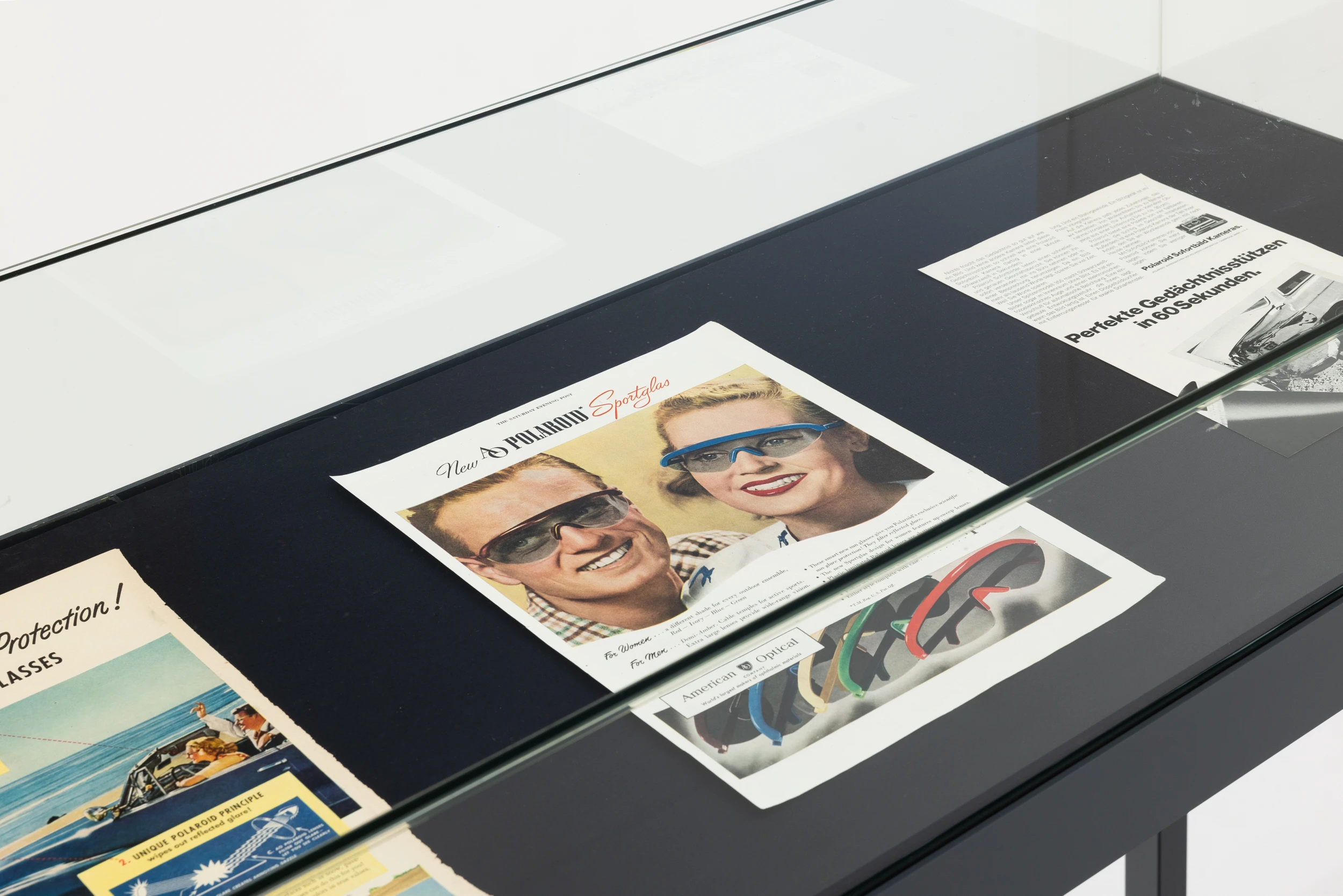
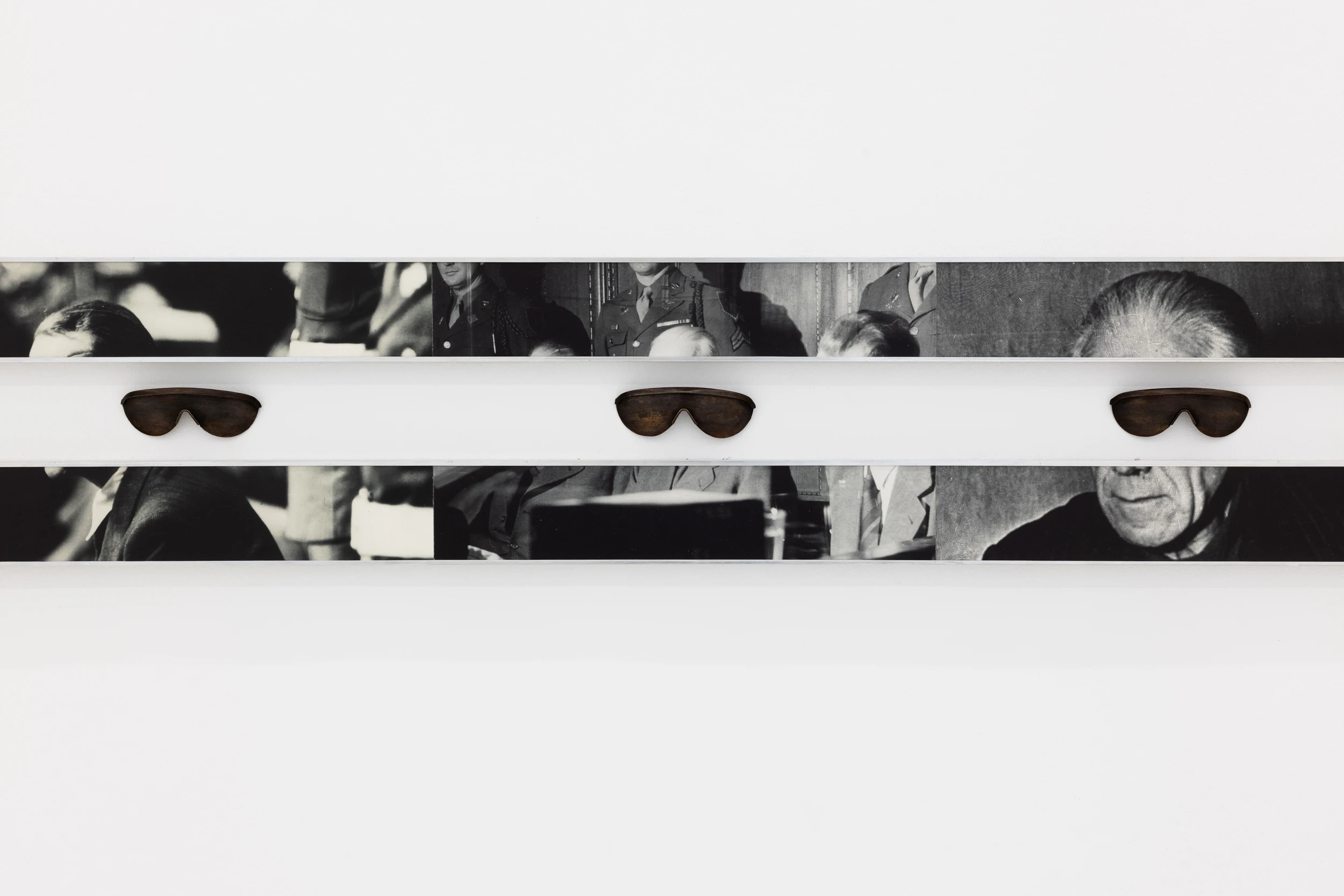
Upon entering the exhibition on the upper floor of a historic building in the heart of Hannover, visitors find themselves in a bright, white room. The large wall of windows is covered with white, translucent linen, flooding the hall with natural daylight. Warm spotlights are directed at 21 pairs of bronze sunglasses mounted on the walls, each framed by historical photographs within display rails. The bronze replicas reproduce a model of sunglasses designed and manufactured by American Optical, the oldest and largest optical company in the United States, in cooperation with Polaroid. The model, introduced in 1945, was distributed by the US military to the Nazi defendants accused of war crimes and crimes against humanity at the Nuremberg Trials in 1946.
As is often the case in Jonas Höschl’s artistic practice, his works take historical events and the photographs documenting them as their point of departure, using design objects to explore questions surrounding the political production of documentary images. In conversation, art and photography historian Dr. Mira Anneli Naß speaks with the artist about the ceiling lighting in Courtroom 600, the film score of Leni Riefenstahl’s Nazi propaganda film Triumph of the Will, and Corey Hart’s 1980s synth-pop hit Sunglasses at Night, exploring how these references inform his work.
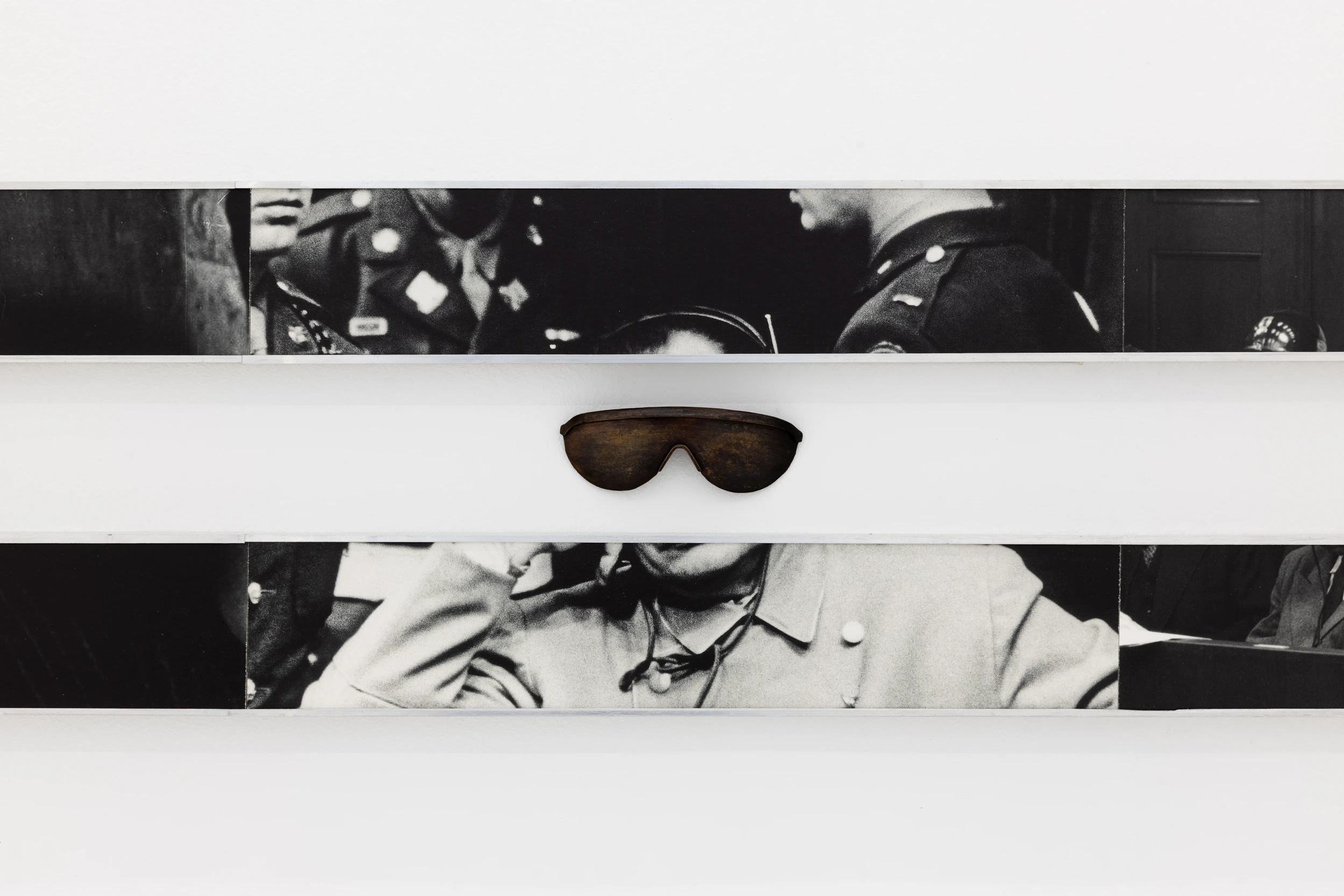
Abb.: Jonas Höschl, “Der helle Saal”, 2026. Installationsansicht Preis des Kunstvereins 2026, Kunstverein Hannover, 2026. Foto: Andre Germar
Your installation Der helle Saal (2026) incorporates photographs of Nazi perpetrators such as Hermann Göring and Hans Frank wearing sunglasses in the courtroom. These photographs have become part of the collective visual memory of the Nuremberg Trials. What is the story behind these images, and what first caught your attention about them? And what role did the sunglasses play in the international press coverage of the trials?
I stumbled upon these very images of Göring and Frank wearing sunglasses while conducting research and wondered what the story behind them was. The Nuremberg Trials and the atrocities committed under the Nazi regime were to be reported on extensively in the international press. This required continuous documentation through film and photography without the use of flash, which led to the installation of exceptionally powerful ceiling lights in Courtroom 600. Concerned that the defendants might complain of physical discomfort, and that the public might perceive the proceedings as undemocratic, the Allies provided the defendants with sunglasses. Yet this gesture produced a striking contradiction: the very light intended to make the proceedings visible to the cameras also allowed the defendants to retreat behind the darkness of their sunglasses.
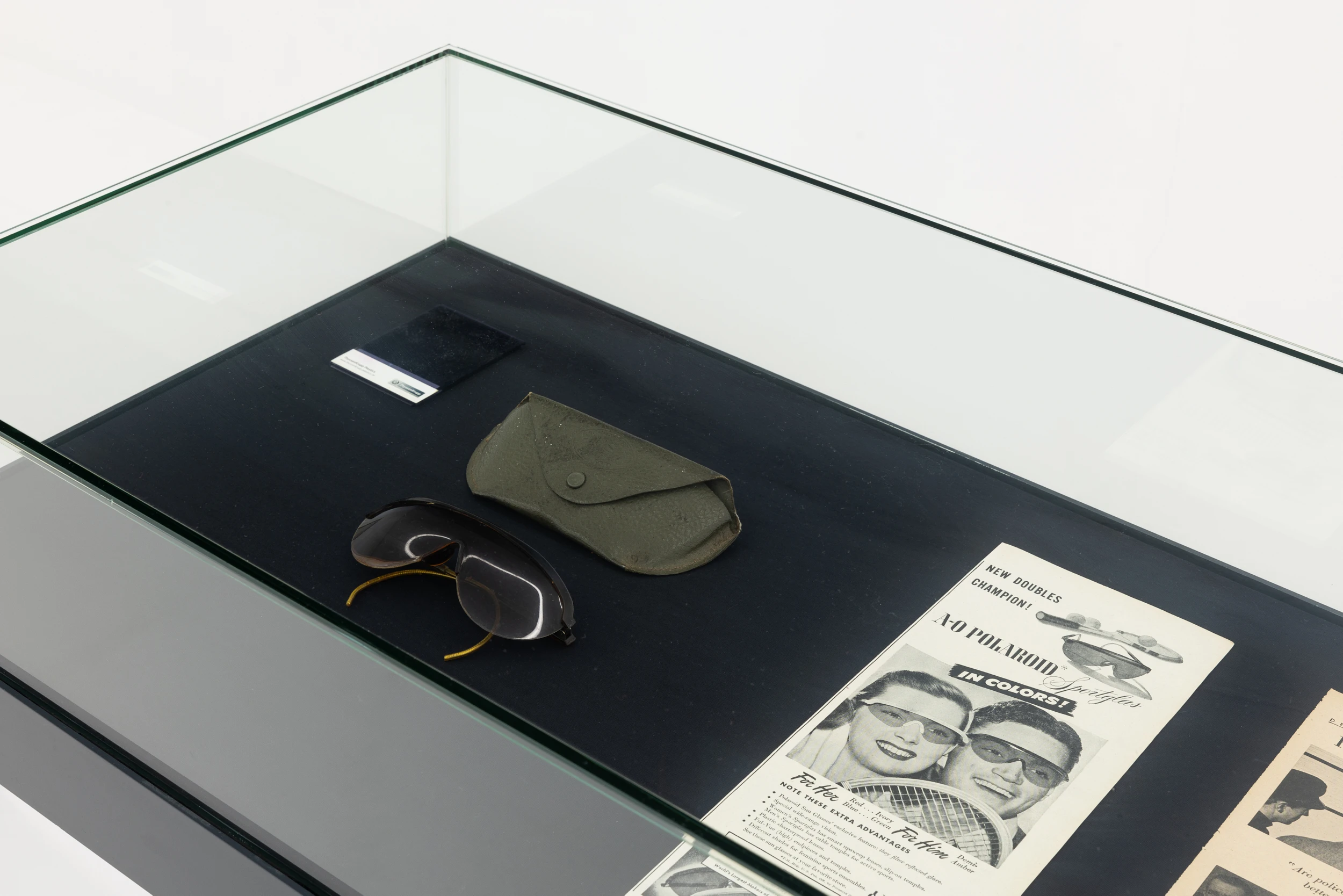
Abb.: Jonas Höschl. Installationsansicht Preis des Kunstvereins 2026, Kunstverein Hannover, 2026. Foto: Andre Germar
The installation fills the entire exhibition space, with the sunglasses extending along the walls in a continuous sequence, framed by the historical photographs. Only on closer inspection does it become apparent that three gaps interrupt the sequence: parts of the photographs are present, but the corresponding bronze sunglasses are missing. How did these three gaps come about?
The 21 pairs of sunglasses represent the 21 defendants who stood trial, although 24 people had been indicted. Two of the defendants escaped the proceedings by taking their own lives, while in one of these cases, the person’s whereabouts remained unknown at the outset of the trial. Another defendant was unable to participate due to his state of health. The three gaps therefore stand for the three individuals who were indicted in absentia.
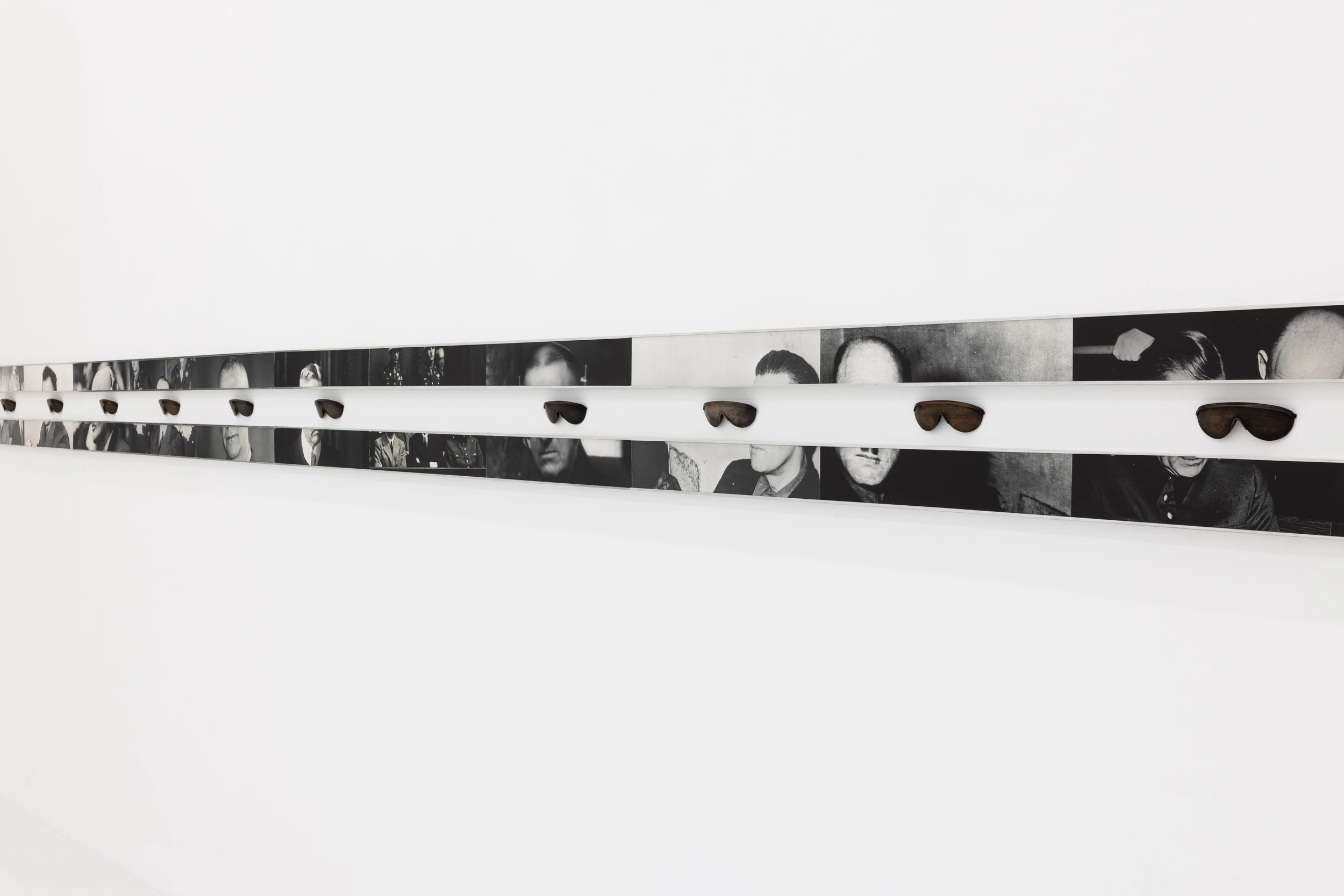
Abb.: Jonas Höschl, “Der helle Saal”, 2026. Installationsansicht Preis des Kunstvereins 2026, Kunstverein Hannover, 2026. Foto: Andre Germar
In the first room, one can already hear orchestral music leading into a second, darkened room with cinema seats. Here, your video work Triumph des Willens, Cover (2026) is presented, although it is conceived primarily as a sound work. Why do you take this detour through music when your practice so often revolves around questions of photography and the photographic image?
Leni Riefenstahl’s Nazi propaganda film Triumph of the Will (1935), about the NSDAP’s Sixth Party Congress in Nuremberg in 1934, has already been extensively examined from the perspective of visual theory. The film score by Herbert Windt, however, which is just as powerful a propagandistic tool as the images, has received comparatively little attention. I therefore commissioned the composer and conductor Felix Gerhart to create a reinterpretation of the score, which was originally written for a large orchestra. In this “cover,” the melody remains largely recognizable, while the scale, density, and impact of the original are fundamentally altered. The ensemble has also been radically reduced to just six string players.
The work was recorded for almost two hours on the former Nazi Party Rally Grounds in Nuremberg. Could you imagine the work functioning as a live performance as well? And what significance does this historical site have for the recording of this altered cover version? Does the setting also evoke the idea of a problematic reenactment? And do current authoritarian dynamics in German society, as well as around the world, play a role here—as a return of the past in a new guise?
No, I couldn’t imagine this work as a performance. My video and sound piece lasts exactly as long as the original film, and although it’s primarily conceived as a sound piece, it’s important to me to stay as close as possible to the original form by presenting it as a video documentation of the live performance—even with movie theater seats. As for the setting, I don’t feel any discomfort about it being a problematic reenactment—after all, I didn’t shoot a music video there like Bushido & Shindy did with G$D (Gott sei Dank) (2015). On the contrary, the work takes the location seriously in a documentary sense, in all its sober and terrifying fragility, and keeps itself very much in the background cinematically through a central camera angle and a one-take shot.
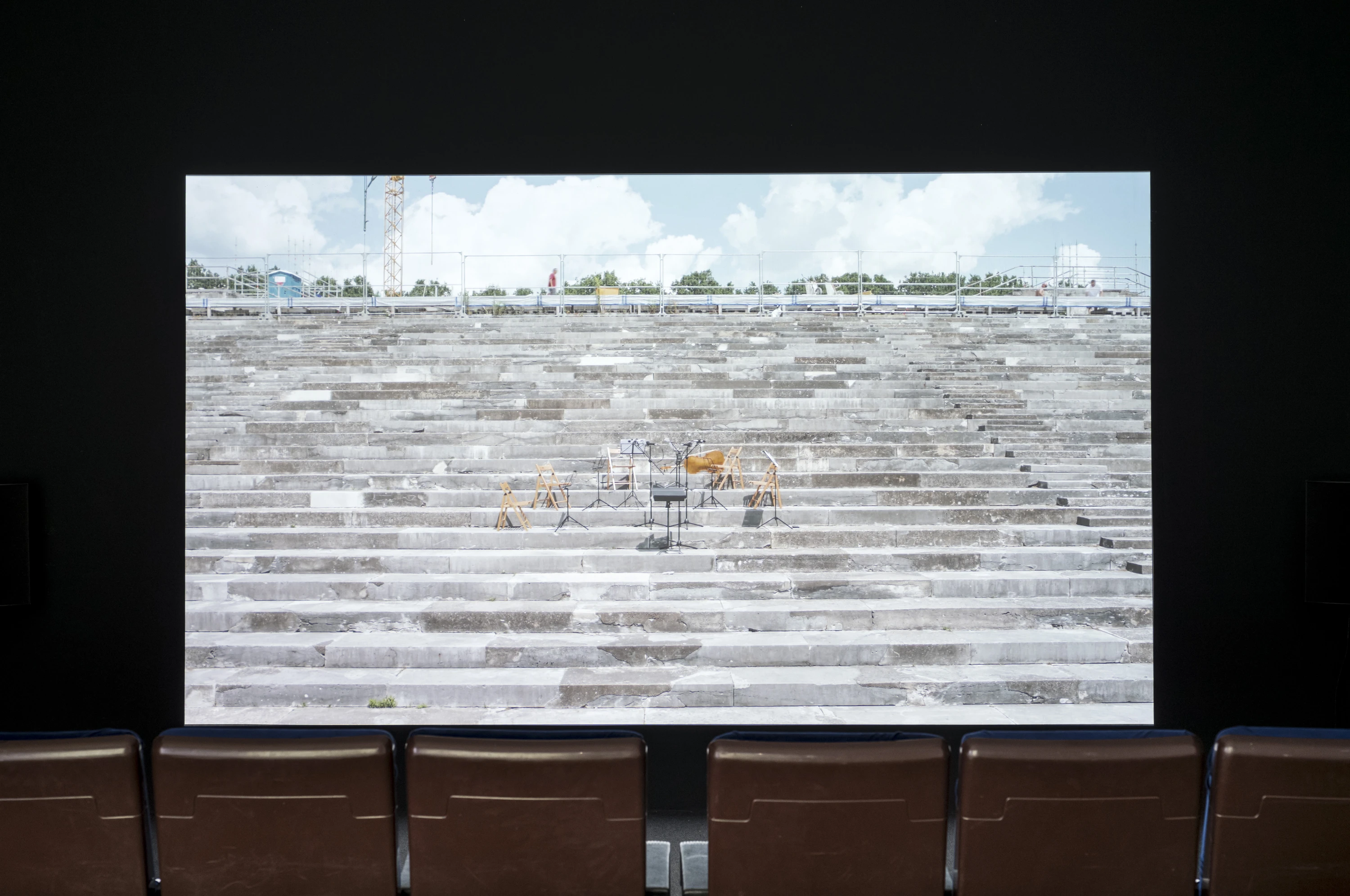
Abb.: Jonas Höschl, “Triumph des Willens, Cover”, 2026. Installationsansicht Preis des Kunstvereins 2026, Kunstverein Hannover, 2026. Foto: Mathias Völzke
Another key aspect of the work is that construction workers can be seen in the background of the shot, carrying out maintenance work on the grounds of the NSDAP Reich Party Congresses. At times, the sounds of the construction work even drown out the music. It is only through this juxtaposition that it becomes clear that the work ultimately addresses the question of how we can come to terms with our cultural heritage from the Nazi era in the present day. From this, conclusions can also be drawn regarding the resurgence of the far right.
After moving through the exhibition, one finally emerges into a bright final room. Here, we are confronted with five large-scale, brightly colored text-and-image graphics that continue your engagement with the sunglasses from the Nuremberg Trials, yet depart from the restrained documentary visual language of the rest of the exhibition. How did these colorful motifs come about?
Throughout the process of working on the piece, I kept thinking about Corey Hart’s song Sunglasses at Night. The music video was filmed in a prison, which led me to draw various associations with the Nuremberg Trials through elements such as police officers, stamped documents, and prison corridors. The graphics combine stills from the video with quotations from a letter written by a US soldier to his father, in which he describes receiving the sunglasses of the defendant Hans Frank as a gift from the head of the prison at the Nuremberg Trials. The color palette is based on the spectrum of colors used in the Polaroid logo.
What have you taken away from your extensive engagement with the sunglasses as a fashion product?
The cultural implications of sunglasses are fluid and continually shift depending on the context in which they appear. They can serve the very practical function of protecting the eyes from sunlight, but just as sunglasses can allow someone to hide behind them, they can also draw attention to the person wearing them, elevating them to the status of a star.
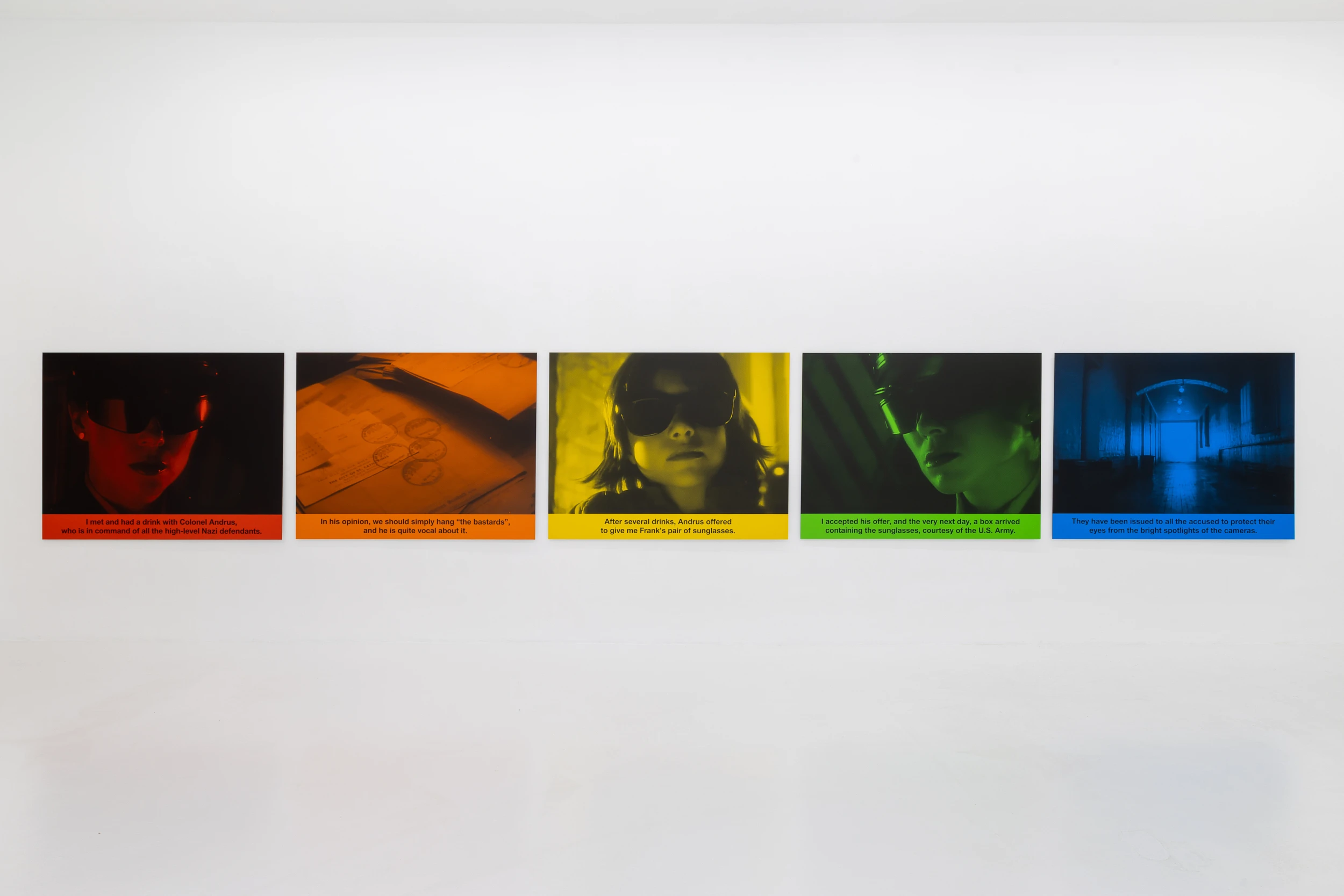
Abb.: Jonas Höschl, “Oppressive Light”, 2026. Installationsansicht Preis des Kunstvereins 2026, Kunstverein Hannover, 2026. Foto: Andre Germar
One final question: To what extent does your work, which is very poppy, fashionable, and Instagrammable, perhaps also contribute to a kind of aestheticization of Nazism and the Nazi war criminals on trial? To what extent is this series itself part of what you are trying to critically engage with as an artist—namely, the pop-cultural appropriation of Nazi aesthetics? In his 1982 essay Reflets du nazisme the historian Saul Friedländer described this phenomenon in the cultural industries of the late 1970s and early 1980s, when a renewed fascination with the Third Reich and fascist aesthetics became visible. He argued that Nazism was being transformed into little more than a consumer product or a myth. This cultural context included films and literary works by Hans-Jürgen Syberberg, Rainer Werner Fassbinder, and Luchino Visconti; exhibitions such as Inszenierungen der Macht – Ästhetische Faszination im Faschismus at the nGbK in Berlin in 1987 and Skulptur und Macht at the Akademie der Künste in Berlin in 1983; as well as the use of swastikas and Nazi salutes in works by artists such as Georg Baselitz, Helmut Federle, Markus Lüpertz, and Anselm Kiefer. In his discussion of the German Pavilion at the 1980 Venice Biennale, where Baselitz and Kiefer presented their work, art critic Werner Spies referred to this as an “Überdosis an Teutschem”—an “overdose of Germanness.”
What role do these historical debates and artistic engagements play for you?
These historical debates are very important to me. I believe art always faces the challenge of ensuring that the subject matter doesn’t simply become an object and that engaging with it doesn’t become an end in itself. In that sense, I’ve always found the self-righteous works by the artists you mentioned repulsive, and they were, in fact, sharply criticized by colleagues at the time. One example is Martin Kippenberger’s work Heil Hitler Ihr Fetischisten (1984), which is meant to be understood as a commentary on the pretentious posturing of those very artists engaged with National Socialism. I’ve always felt closer to later works, such as Christoph Schlingensief’s performance Bitte liebt Österreich (2000) or Katharina Sieverding’s Deutschland wird deutscher (1992), in which the artists took personal responsibility and thereby explicitly stepped outside the protective space of art. On the other hand, art must also be aware of its limits so that it does not degenerate into political and agitational kitsch, as is the case, for example, with the art collective Zentrum für politische Schönheit. In my artistic work and in the exhibition at the Kunstverein Hannover, I try to condense history and establish connections between historical imagery and motifs from pop culture. All of these images already exist and embody the aesthetics of their respective contexts. Through juxtaposition and condensation, it becomes clear just how strongly the pop-cultural gesture was already embedded in the moment the sunglasses were handed out to the defendants and how it contributed to their glorification. To avoid repeating this, I have removed the faces of the Nazi war criminals so that the bronze replicas of the sunglasses can take center stage.
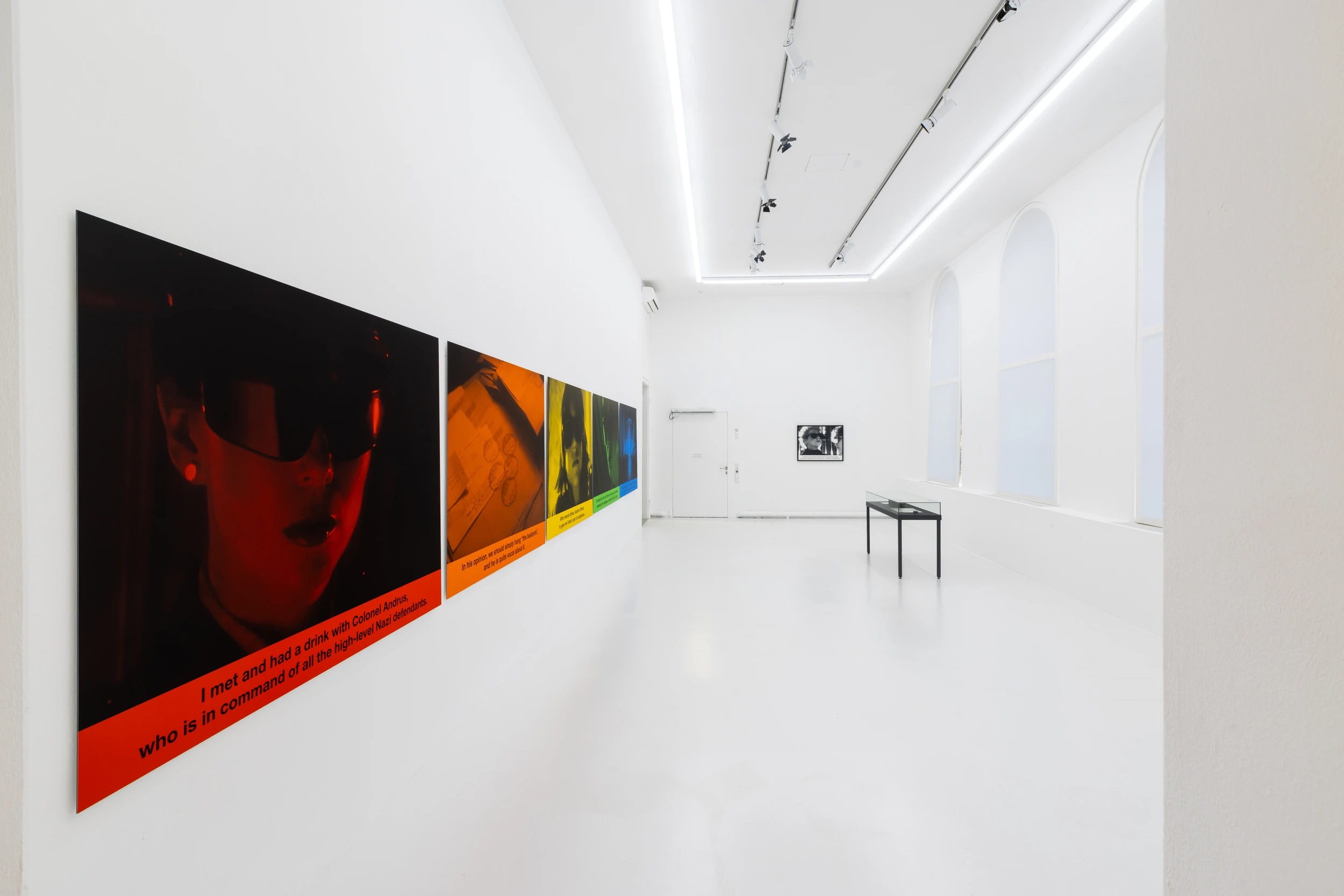
Abb.: Jonas Höschl, “Oppressive Light”, 2026. Installationsansicht Preis des Kunstvereins 2026, Kunstverein Hannover, 2026. Foto: Andre Germar
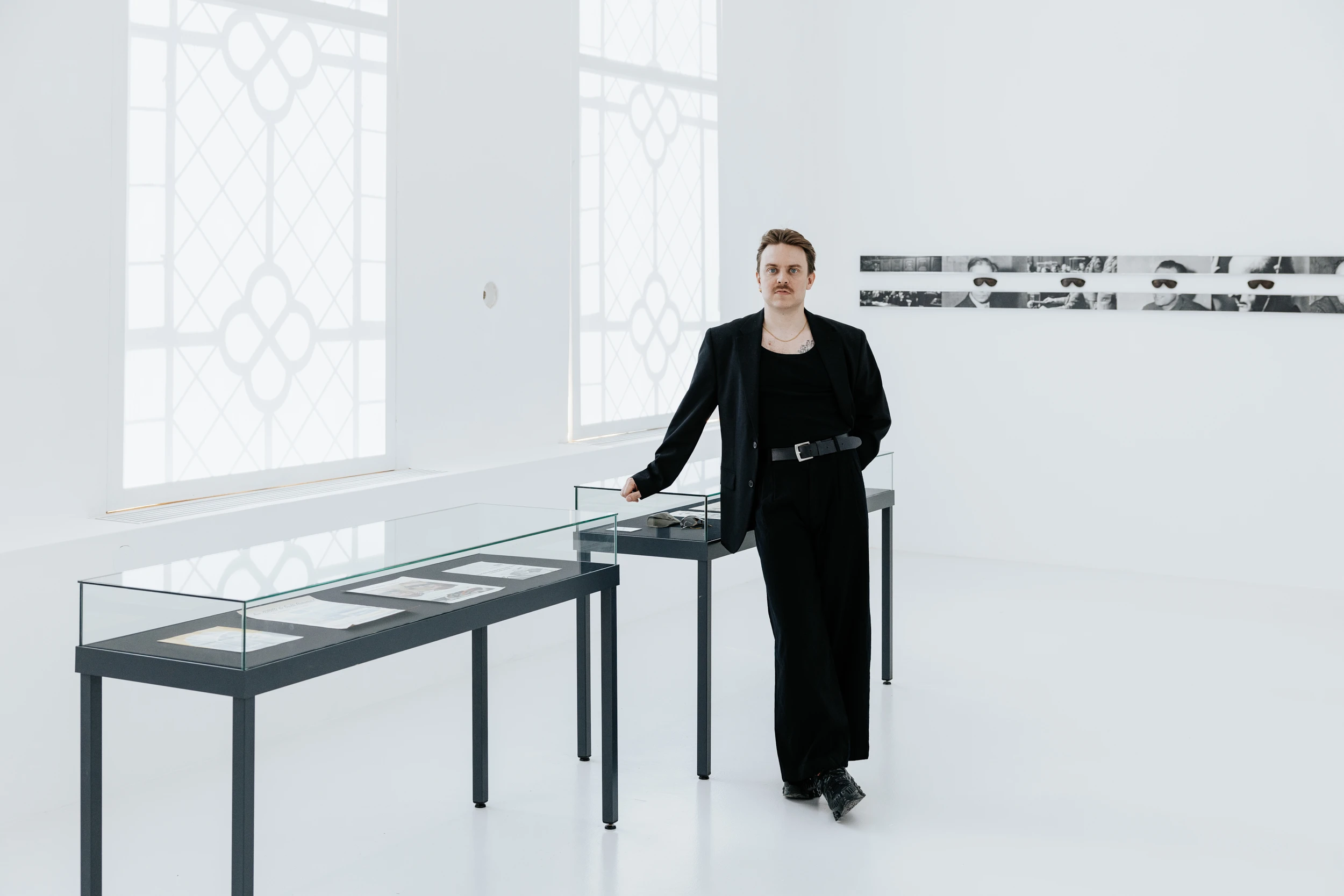
Abb.: Jonas Höschl. Installationsansicht Preis des Kunstvereins 2026, Kunstverein Hannover, 2026. Foto: Andre Germar
The exhibition for the Kunstverein Hannover Prize 2026 runs through November 1. Jonas Höschl’s works will then be on view in his solo exhibition “Men in Shades” at the Anton Janizewski Gallery in Berlin from November 13 through December 19, 2026.